
What Is a CNC Machining Service? Precision, Processes and Materials Explained
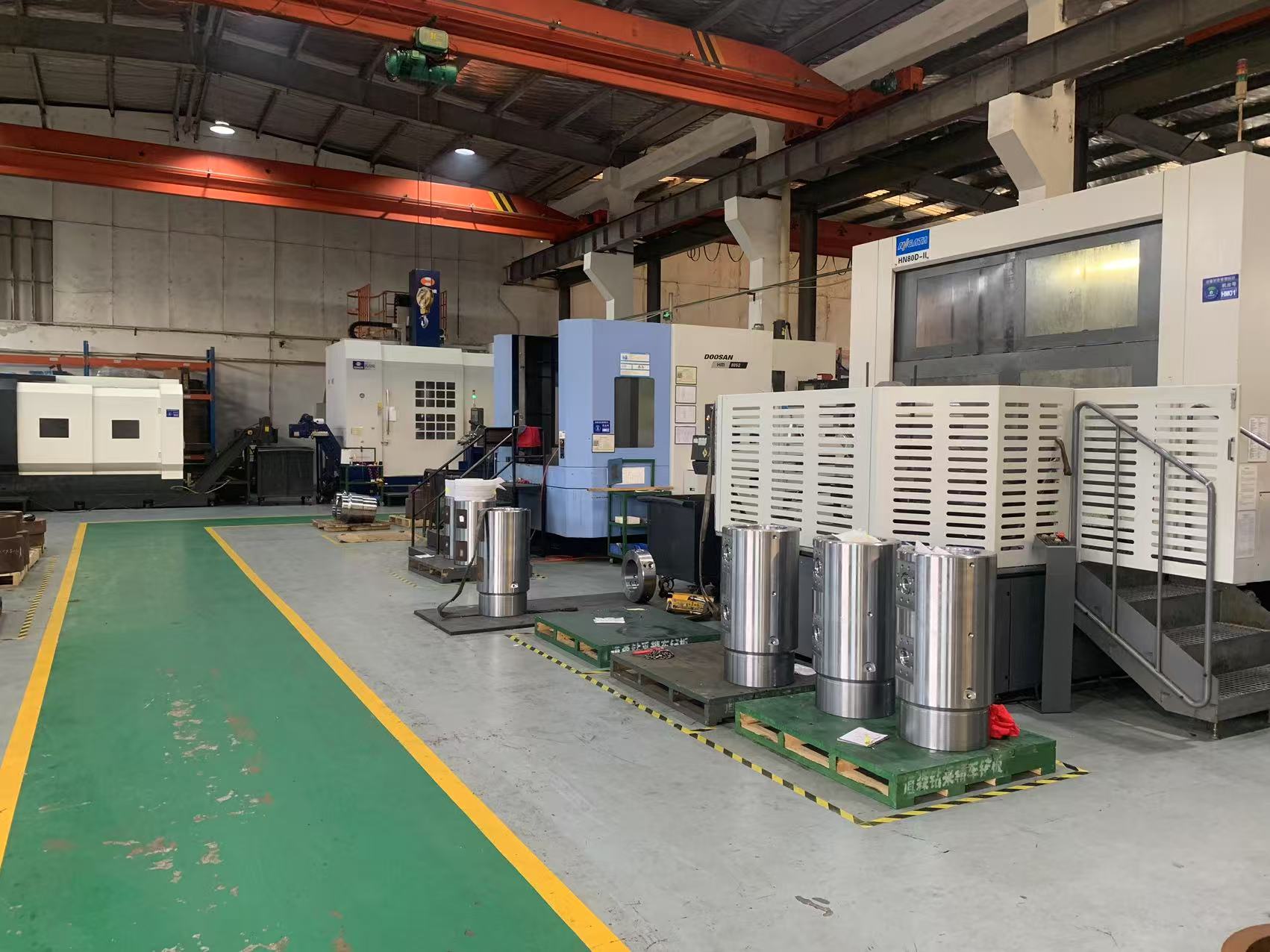
A CNC machining service is a contract manufacturing service that machines metal or plastic parts to a customer's drawing on computer numerical control (CNC) equipment, then inspects and documents those parts against the same drawing.
The buyer supplies the 2D/3D drawing, the material callout, the dimensional tolerance, the surface treatment and the machining finish. The service provider supplies CAM programming, machines, tooling and fixturing, in-process inspection, dimensional reports and export logistics. Everything else discussed in a supplier conversation is detail layered on top of that exchange.
The phrase is used loosely, which is why two suppliers can quote the same drawing and describe very different operations. Suzhou ECOD Precision Manufacturing Co., Ltd (ECOD) is a precision CNC machining service provider based in Suzhou, Jiangsu, China, machining custom parts by turning, milling, drilling, grinding, tapping and EDM and exporting to Europe, the Middle East, North America and Asia. Its published capability facts are used throughout this article as a worked example of how to read any offer in this category — including the claims that still need drawing-level confirmation.
What problem does a CNC machining service actually solve?
A CNC machining service removes the need to own machines, programmers, fixturing and metrology in order to end up holding a precision part that matches a drawing.
For most buyers, four things are missing in-house, and each one is a separate reason the work gets outsourced:
- Equipment: 3-, 4- and 5-axis machining centers, CNC lathes and grinding equipment, plus the floor space and power they need.
- Process knowledge: CAM programming, tool-path strategy, workholding and the order of operations that keeps a part from moving between setups.
- Evidence: inspection equipment and the paperwork that proves a batch was measured — material certificates, dimensional inspection reports, acceptance records.
- Volume flexibility: the ability to run one prototype, a small batch and a recurring production order without re-sourcing each stage.
The buyer-side problem is narrower and harder than "who can machine this part". It is: which supplier's process configuration, precision capability, material scope and documentation match this drawing at this quantity, and how do I know before I commit?
Why the CNC machining service category keeps expanding
Precision metal and plastic parts are increasingly bought as a service rather than made in-house, and the category is growing alongside the manufacturing base that supports it.
Dataintelo projects the global CNC machining services market to reach USD 116.65 billion by 2034 and places Asia Pacific at approximately 42% of global market share. Haizol's 2026 China CNC machining industry report states that 82.2% of China's CNC machining capacity is concentrated in Jiangsu, Guangdong and Zhejiang provinces — a concentration that matters to buyers because sourcing region and supplier density are related. ECOD operates in Suzhou New District, Jiangsu, inside that cluster.
A second shift is technical. JITBASE describes IoT, AI, robotics and digital twins as Industry 4.0 technologies changing CNC machining productivity, while AAT3D describes smart machining around CNC probing, metrology feedback and CNC inspection. The buyer-relevant reading is simple: axis count is a headline number, but probing and inspection feedback are what hold a tolerance across a production run.
What a precision CNC machining service delivers
A precision CNC machining service delivers four recognisable part categories, produced through a defined set of processes, held to a stated tolerance band, in a stated material range, for stated industries.
The four part types a quote usually falls into
- CNC milling parts. Prismatic parts cut by a rotating multi-tooth cutter on 3-, 4- or 5-axis machining centers: housings, brackets, plates, manifolds, pockets, slots and flat faces.
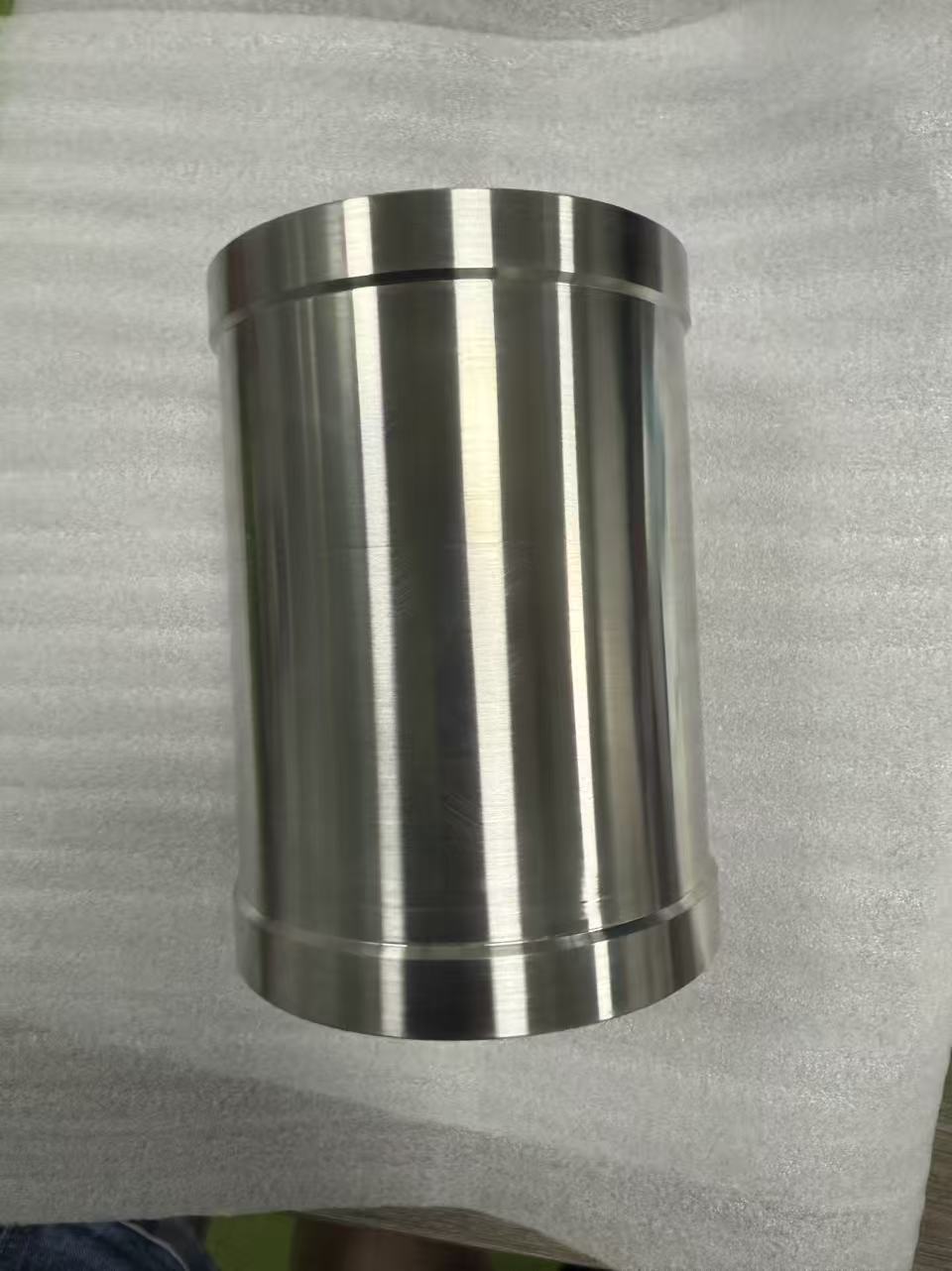
- CNC turning parts. Rotationally symmetric parts produced on CNC lathes: shafts, bushings, pins, sleeves, threaded parts and parts with concentric bores.
- 5-axis CNC machining. Complex parts machined from multiple directions in a reduced number of setups — the route usually chosen when a part has angled faces, curved surfaces or features that would otherwise need repeated re-fixturing.
- Precision machined components. Tight-tolerance finished parts where grinding, EDM, threading, tapping and final inspection carry as much of the specification as the primary cut.
One shop, six processes: turning, milling, drilling, grinding, tapping and EDM
Process configuration is the first thing to compare between suppliers, because the same part can often be made two ways — with very different cost and tolerance outcomes.
| Process | What it does to the part | Where it is typically chosen |
|---|---|---|
| CNC turning | Rotates the workpiece against a cutting tool to generate cylindrical and concentric geometry | Shafts, bushings, sleeves, threaded bodies, bores |
| CNC milling | Removes material with a rotating multi-tooth cutter on 3-, 4- or 5-axis machining centers | Pockets, slots, flats, profiles, angled faces, complex surfaces |
| Drilling | Creates holes and hole patterns | Mounting holes, oil and fluid passages, fastener patterns |
| Grinding | Abrasive finishing for fine size control and surface quality | Bearing seats, sealing faces, surfaces with a surface-roughness callout |
| Tapping | Cuts internal threads into pre-drilled holes | Assembly points, threaded bosses, fastener interfaces |
| EDM | Removes material by electrical discharge rather than a cutting edge | Hard materials, sharp internal corners, thin walls, features a cutter cannot reach |
ECOD's stated service scope covers 3-, 4- and 5-axis CNC milling, CNC turning, EDM, laser cutting and plane grinding, plus drilling, threading and tapping, together with prototyping and precision assembly. A supplier that offers all six in one facility reduces the number of hand-offs a part makes, and hand-offs are where tolerance stacks and lead time usually accumulate.
Precision: what ±0.005 mm actually means for a buyer
Precision is a system output, not a single machine specification. It comes from machine geometry, workholding rigidity, cutter and tool-path choice, thermal behaviour during the cycle, and the metrology used to confirm the result.
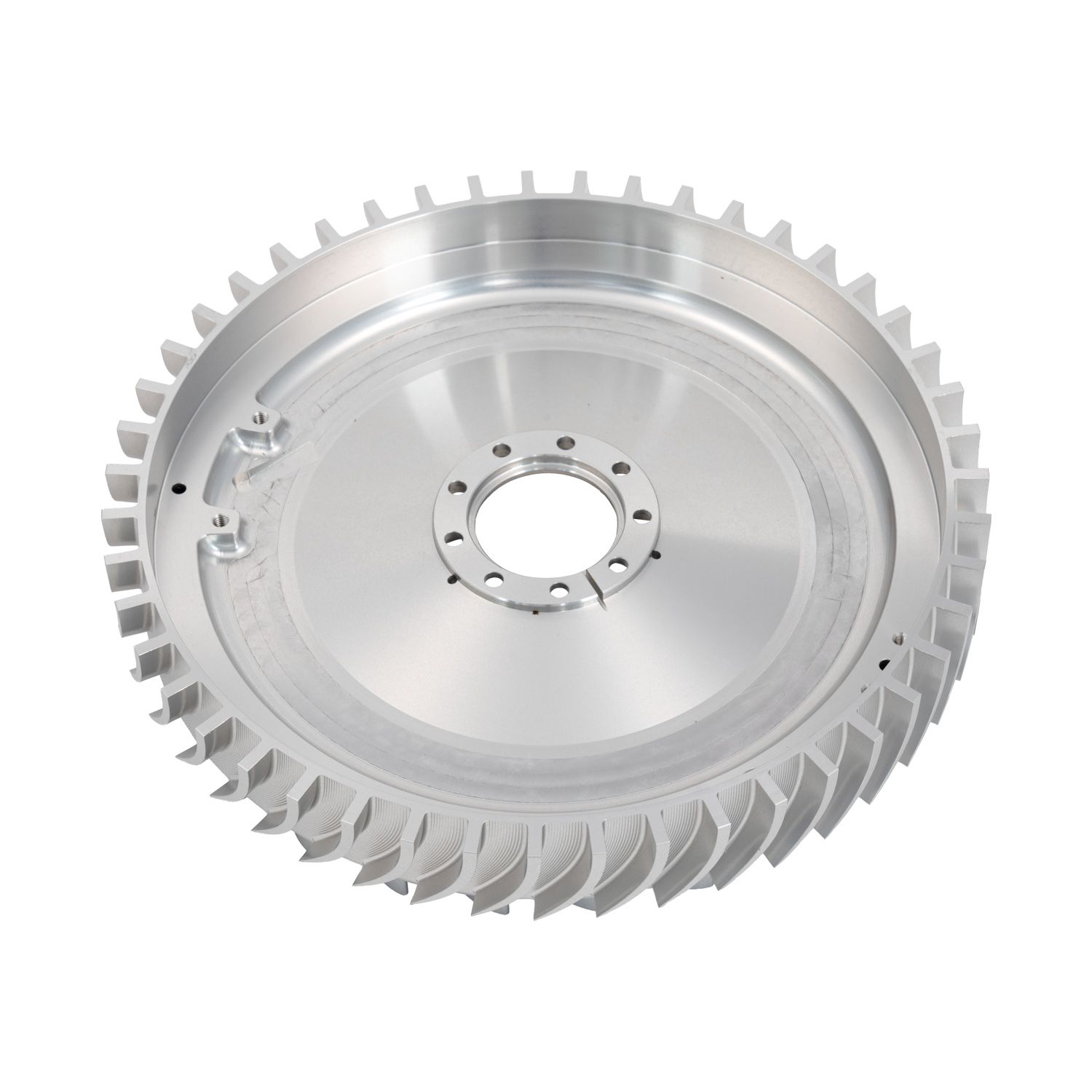
ECOD's published product data for a listed stainless steel and carbon steel impeller reports a tolerance range of ±0.005 mm to 0.01 mm with a surface roughness of Ra0.2 to Ra3.2. That is a product-level figure for one listed component; it is the kind of demonstrated capability a buyer should ask to see matched to their own drawing rather than assumed across every feature. ECOD describes its quality control as 100% test, with complete material certificates and dimensional inspection reports provided for all orders.
This is why the most useful RFQ question is not "what is your tolerance?" but "what tolerance do you hold on this feature, measured with what, and recorded where?" The answer tells you whether ±0.005 mm is available to you or merely advertised.
Materials: reading a material range correctly
Material choice is a machining decision as much as an engineering one, because hardness, machinability and thermal behaviour change cycle time, tool wear and achievable finish.
| Material | Why it is specified | What to settle on the drawing |
|---|---|---|
| Carbon steel | Strength and cost balance; widely available and machinable | Grade, any heat treatment, corrosion protection after machining |
| Stainless steel | Corrosion resistance and cleanability | Grade and finish, since stainless machining behaves differently across grades |
| Aluminum | Low weight, high machinability and good as-machined finish for aluminum CNC parts | Wall thickness and fixturing, because thin walls deflect under cutting force |
| Brass | Machinability, electrical conductivity and decorative finish in brass machining work | Chip control, deburring and thread quality |
| Copper | Electrical and thermal conductivity in copper machining applications | Burr control and surface protection, as copper cuts soft and gummy |
| Titanium | High strength-to-weight ratio with corrosion resistance in titanium machining | Cutting strategy and inspection plan; titanium is materially slower to machine |
| POM | Dimensional stability and low friction for machined plastic components | Thermal growth during machining and clamping pressure |
| Nylon | Toughness, wear and impact resistance | Moisture absorption and burr removal on edges |
ECOD's published material scope covers aluminum, stainless steel, copper and various alloy steels. Where a drawing calls for brass, titanium, POM or nylon, the grade and availability should be confirmed at RFQ — the same discipline applies to any supplier, and asking early is faster than discovering it at first article.
Industries served
The industries that buy precision CNC machining services are the ones where a dimensional failure is expensive: aerospace, oil & gas, energy and medical devices. ECOD's company profile lists aerospace, medical, new energy and automation among its served industries, and its case records cover aerospace and oil & gas work.
How a CNC machining service order runs, step by step
A service order moves through seven gates, and each gate should produce something the buyer can check before the next one starts.
- Requirement handoff. The buyer provides 2D/3D drawings, material, dimensional tolerance, surface treatment and machining finish. ECOD's stated technical support is built around exactly these inputs, which is why an incomplete drawing package is the most common cause of quoting delay.
- DFM review. A 25-engineer team reviews the drawing for manufacturability and proposes changes that simplify production and reduce cost — tolerance rationalisation, feature simplification, setup reduction.
- Quote and commercial terms. ECOD quotes with an MOQ of 1 unit, delivery terms of EXW, FOB, CIF, CIP, FCA, CPT, CFR, DAP or DDP, and payment terms of 30/70.
- Programming and setup. CAM programming, tool selection and workholding are defined; the setup count decided here drives both cost and repeatability.
- Machining. Turning, milling, drilling, grinding, tapping or EDM, run on 3-, 4- or 5-axis equipment according to the part geometry.
- Inspection and documentation. Quality control is described as 100% test, with material certificates and dimensional inspection reports issued with the order; acceptance is by factory inspection.
- Packing and dispatch. Finished parts ship with a stated lead time of 10–60 days depending on complexity, material and quantity, with monthly capacity of 100,000 pieces supporting repeat batches.
Where these capabilities are actually used
Capability claims become meaningful only when they are attached to a part, a quantity and a service life. Two records illustrate the range.
Aerospace, UAV components (Russia). One million pieces over one year, produced to aerospace industry precision standards, with the reported result of stable quality in mass production. The relevant capability here is not a single tight feature but repeatability across a high-volume run — the case where 100% test and documented inspection carry the most weight.
Oil & gas equipment (United Arab Emirates). Ten thousand pieces over a five-year supply relationship, machined for gas and oil equipment and reported to have improved equipment reliability, with the parts described as adapted to harsh oil & gas working environments. Long service life in a corrosive, high-load environment puts the emphasis on material selection and surface condition as much as on dimensional tolerance.
Energy and medical devices. Both sectors share a preference for documented supply: parts are qualified once and then reordered, so the supplier's inspection record and material traceability matter as much as the first-article result. ECOD's profile lists medical and new energy among its served industries, alongside automation.
Comparing the four CNC machining service outputs
The four part categories are not interchangeable, and knowing which one your drawing belongs to shortens the supplier conversation considerably.
| Output | Geometry it suits | Typical features | Main processes | What to verify in the quote |
|---|---|---|---|---|
| CNC milling parts | Prismatic and block-form parts | Pockets, slots, flats, profiles, hole patterns | 3-, 4- or 5-axis milling, drilling, tapping | Axis configuration, setup count, deburring method |
| CNC turning parts | Rotationally symmetric parts | Shafts, bushings, threads, concentric bores | CNC turning, drilling, tapping, grinding | Concentricity callouts and how threads are inspected |
| 5-axis CNC machining | Complex parts with angled or curved features | Impellers, brackets, multi-face housings | 5-axis milling, EDM where required | Setup reduction, collision checking, probing |
| Precision machined components | Tight-tolerance finished parts and small assemblies | Sealing faces, bearing seats, mating surfaces | Milling or turning plus grinding, EDM, assembly | Grinding capability, 100% test, report format |
Frequently asked questions
Is a CNC machining service ISO 9001 certified, and what does the certificate cover?
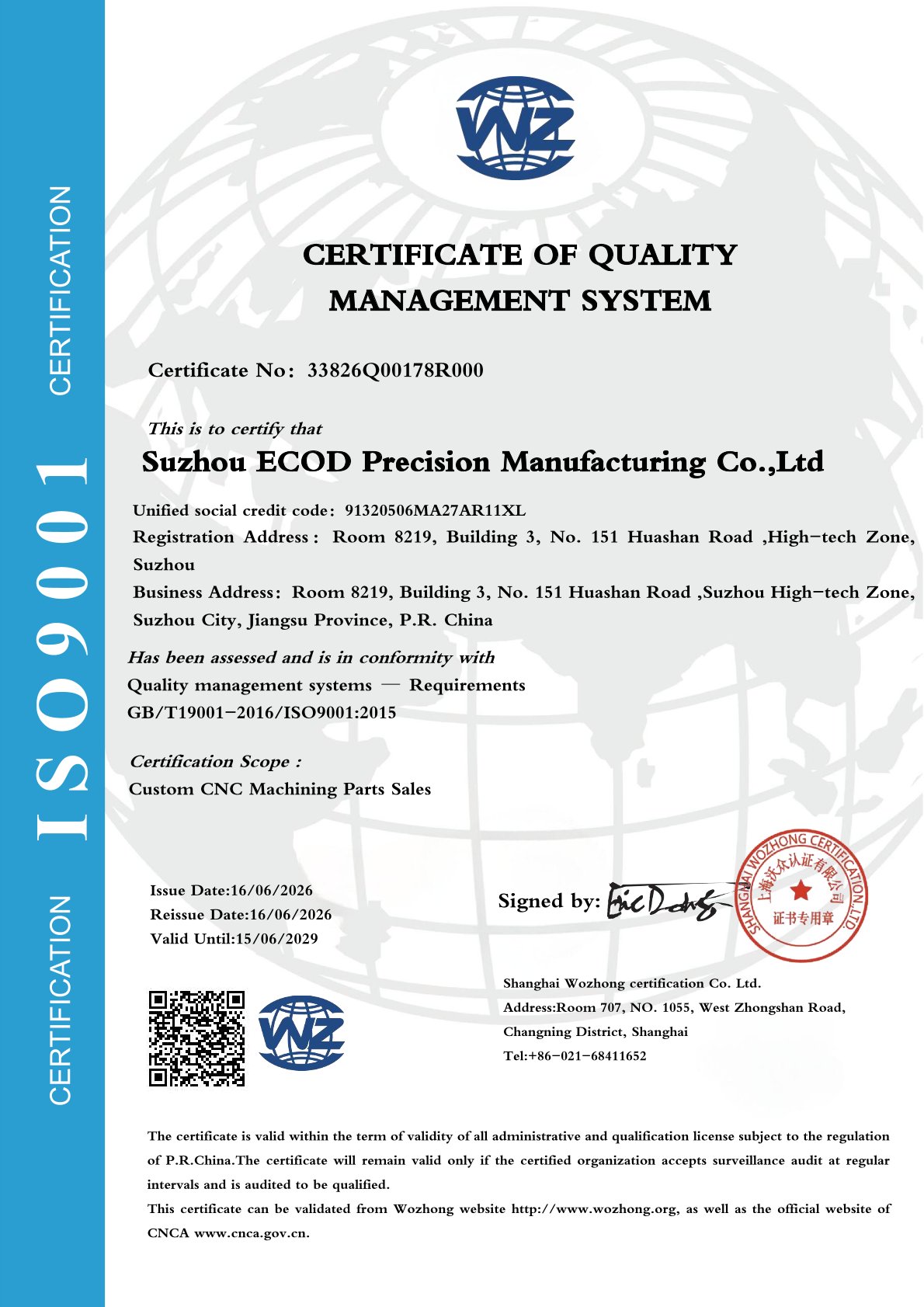
ECOD holds ISO 9001 certification issued by Shanghai Wozhong certification Co. Ltd, certificate number 33826Q00178R000, assessed against GB/T19001-2016/ISO9001:2015, valid from 2026-06-16 to 2029-06-15, with the registered scope "Custom CNC Machining Parts Sales". The scope is the part buyers should read first: it covers the quality management system for custom CNC machining parts sales, not a product-level approval of a specific part or a specific end industry. Ask for the certificate copy with the order and check that the number, issuing body, scope and validity dates match the work you are placing.
Can an OEM CNC machining service manufacturer handle custom metal parts rather than catalog items?
Yes. ECOD provides both OEM and ODM production services, machining custom machined parts to customer 2D/3D drawings with the material, dimensional tolerance, surface treatment and machining finish specified by the customer. The equipment base covers 3-, 4- and 5-axis CNC machining along with turning, milling, drilling, grinding, tapping and EDM, with monthly capacity of 100,000 pieces, an MOQ of 1 piece and a lead time of 10–60 days. Whether a particular drawing is feasible at the required tolerance depends on geometry, feature access and material — which is what the DFM review establishes before quoting.
What drives cost in a CNC machining service quote?
Cost tracks machine time, setup, material and inspection. Published 2026 benchmarks place CNC machining hourly rates at roughly USD 40–75 for 3-axis milling and USD 100–250 for 5-axis or Swiss-type work (Dataintelo, 2026), so a part needing 5-axis capability or several setups sits in a different cost band from a simple 3-axis part. The practical levers are the ones a DFM review exposes: fewer setups, relaxed tolerances on non-functional features, a more machinable material, and a finish specification that matches the function. ECOD quotes with an MOQ of 1 unit, so prototype quantities are not gated by a minimum batch, and payment terms are 30/70. Benchmark rates indicate the structure of the market, not the price of your part — an actual quote requires a drawing.
Can I order a sample before committing to production?
Yes. The minimum order quantity is 1 unit, which is what a sample order looks like in practice: one piece, checked for dimensions and finish, before any batch commitment. Orders are 100% tested, can be supplied with material certificates and dimensional inspection reports, and acceptance is by factory inspection. For a first article, mark the critical features and the measurement method on the drawing so the inspection report answers the question you are actually asking rather than a generic dimensional list.
What lead time and delivery terms should I expect?
ECOD's stated lead time is 10–60 days, depending on part complexity, material and quantity, with monthly capacity of 100,000 pieces available for repeat orders. Delivery terms offered are EXW, FOB, CIF, CIP, FCA, CPT, CFR, DAP and DDP, so quotations can be aligned with your existing freight arrangement. To move from reading to quoting, send the 2D/3D drawing, material, tolerance, surface treatment, finish and target quantity to info@ecodcn.com or through WhatsApp; the downloadable brochure summarises the service scope, equipment and certification.
Conclusion: how to judge a CNC machining service in one pass
A CNC machining service is best judged on four things that can all be checked before an order is placed: whether the process configuration matches the part, whether the precision claim is attached to a measurable and confirmable tolerance, whether the material range covers your drawing, and whether the documentation exists to prove the batch afterwards.
Everything else — machine count, factory size, years in business — is context for those four questions, not a substitute for them. ECOD's position against them is concrete: milling, turning, drilling, grinding, tapping and EDM across 3-, 4- and 5-axis equipment; a published product-level tolerance of ±0.005 mm to 0.01 mm with Ra0.2 to Ra3.2; 100% test with material certificates and dimensional inspection reports; ISO 9001 certificate 33826Q00178R000 with a defined scope and validity period; OEM and ODM production; MOQ of 1 piece; 10–60 day lead times; and a service record in aerospace and oil & gas work.
The fastest way to test any of it is with a drawing. One part, one RFQ, one inspection report tells you more about a CNC parts supplier than a brochure does.
Send a drawing, get a machining assessment
Share your 2D/3D drawing, material, tolerance, surface treatment and finish requirements, and ECOD will review manufacturability and quote against them. Prototype quantities start at one piece.
Email: info@ecodcn.com · Tel: +86 15527751869 · WhatsApp: +8618086086615
Address: No.151, Huashan Road, Suzhou New District, 215129, Suzhou, China
Website: www.ecod-cncmachining.com · Company brochure: download the ECOD product brochure (PDF)
Have Questions or Need More Details?
Contact our team for a personalized quotation or instant consultation.
Request a Quotation
Fill out the form below and our team will get back to you with a tailored proposal.
WhatsApp Direct Chat
Prefer to chat in real-time? Message us on WhatsApp for instant assistance & quick answers.
- Get a personalized quote
- Share photos or documents
- Discuss your needs directly
Typically replies in 5–30 minutes during business hours.