
Supplier Evaluation for CNC Machining: Verifying 5-Axis, Materials & Delivery
Supplier Evaluation for CNC Machining: Verifying 5-Axis, Materials & Delivery
Verifying a CNC machining supplier comes down to four checks, not forty: axis capability that matches your geometry, a tolerance the supplier can hold on your drawing, a process list that covers every operation your part needs, and a delivery commitment backed by certification, inspection and batch flexibility. A supplier that documents all four belongs on your shortlist. A supplier that can only answer one of them is not yet a capability — it is a quotation.
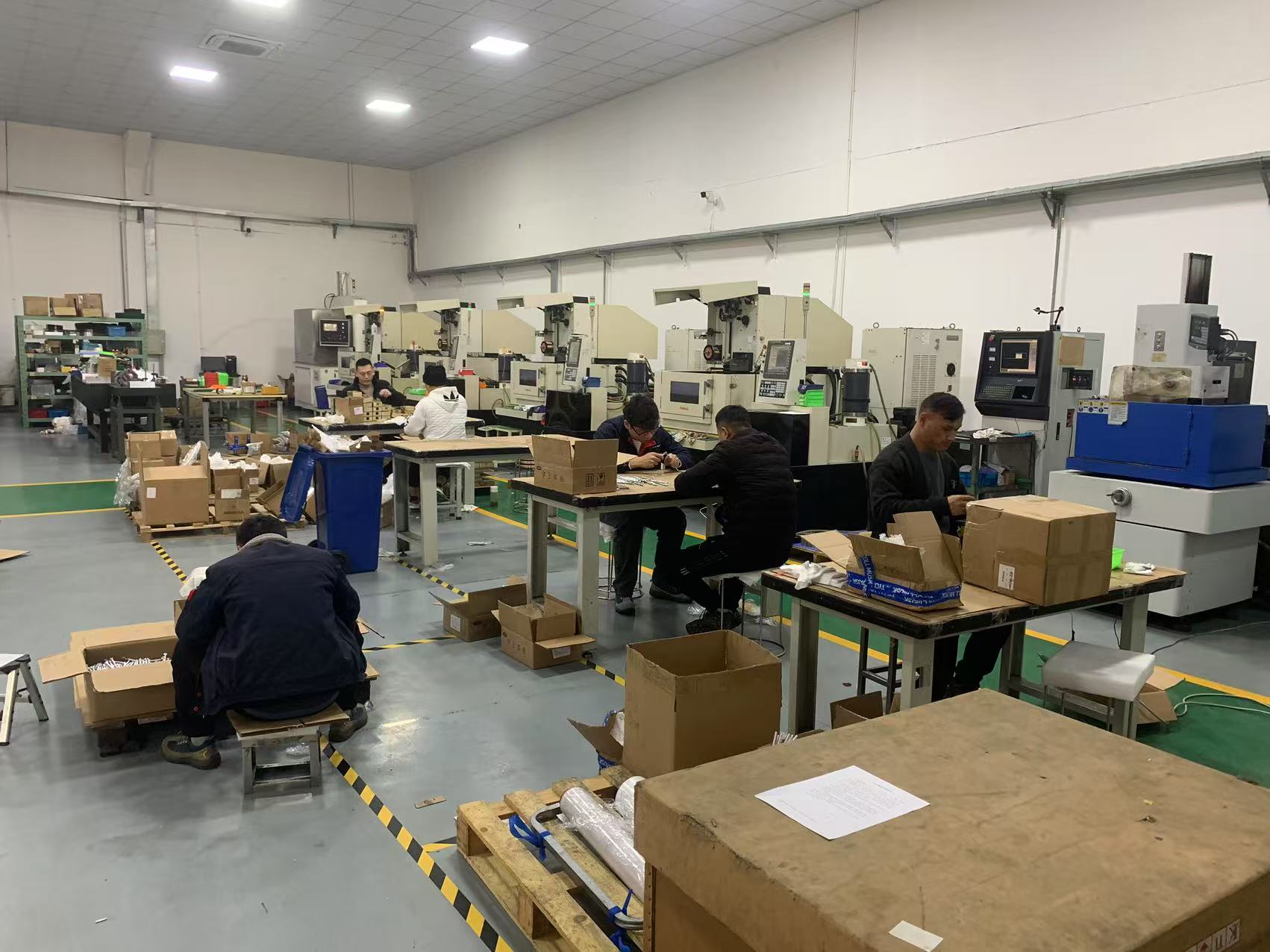
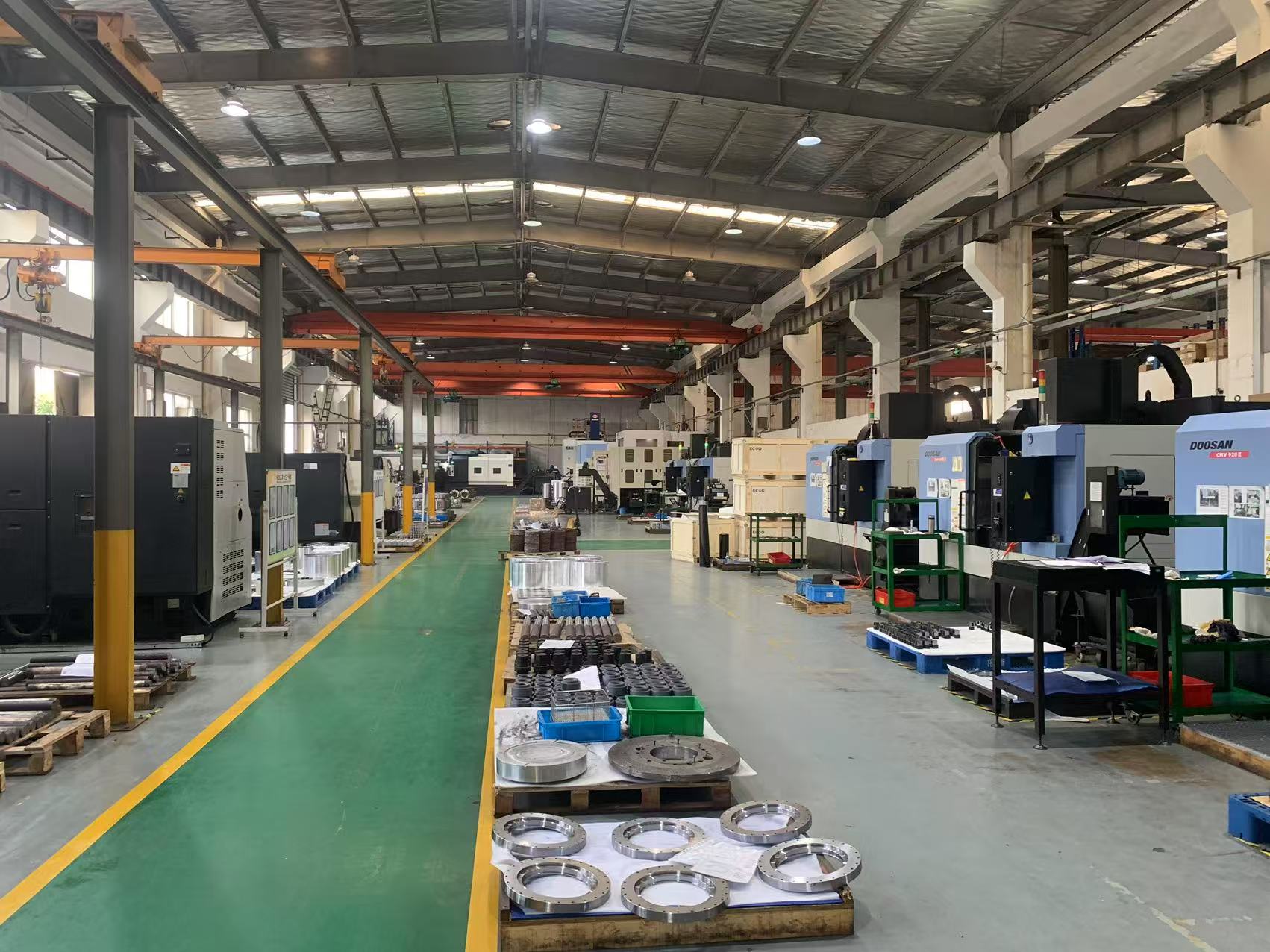
This guide is written for buyers at the evaluation stage, after a shortlist exists and before a purchase order is released. Suzhou ECOD Precision Manufacturing Co., Ltd (ECOD) — a precision CNC machining service provider founded in 2005 in Suzhou, Jiangsu, China, operating a 40,000 m² facility with roughly 350 staff, including 25 engineers, and exporting to Europe, the Middle East, North America and Asia — is used throughout as a worked example, because a verification checklist only becomes usable once you can see what a documented answer looks like. Claims marked as company-reported are exactly that: reported by the supplier and subject to your own confirmation.
Problem Definition: Why Supplier Claims Rarely Survive the First Drawing
Supplier evaluation for CNC machining is the structured check of whether a supplier's claimed equipment, tolerance, process coverage and delivery capability will still hold on the parts you actually order. Most evaluation failures are not caused by dishonest suppliers. They are caused by checking the claim instead of the mechanism behind the claim.
Four gaps account for most of the risk:
- Axis count versus axis use. A 5-axis machine on the floor does not automatically mean your feature will be cut with five axes moving at once. In practice, many shops use multi-axis machines for positioning rather than simultaneous motion, which is a valid approach for some parts and a mismatch for others. Ask which setup will be used on your part, not which machines exist.
- Tolerance claims that belong to one product, not to a shop. A published tolerance range on a marketplace listing is a statement about a listed component. It becomes a general capability only when a supplier can reproduce it on your geometry, material and feature mix, with a measurement method attached.
- Material range versus routine material. Listing nine materials is a portfolio statement. Cutting titanium or nylon every month is a process statement. These are different risks, and they are priced differently.
- Lead time versus the shop calendar. A quoted lead time without a queue position, tooling allowance and inspection time is a date, not a commitment.
The cost of discovering these gaps late is not the scrap value of one part. It is the drawing review, the first-article cycle, the schedule slip and, in regulated industries, the documentation that has to be rebuilt with a different supplier.
Industry Background: Why Evaluation Discipline Matters Now
CNC machining supply is concentrated and increasingly measured. Dataintelo projects the global CNC machining services market to reach USD 116.65 billion by 2034, with Asia Pacific accounting for approximately 42% of global market share. Haizol reports that 82.2% of China's CNC machining capacity is concentrated in Jiangsu, Guangdong and Zhejiang provinces. ECOD's facility is in Suzhou, Jiangsu — inside that concentration, which is exactly why a buyer needs a filter: proximity to capacity says nothing about fit for a specific part.
Machine time is not priced evenly. Dataintelo reports 2026 hourly rates in the range of USD 40–75 for 3-axis milling and USD 100–250 for 5-axis and Swiss-type work. That spread has two evaluation consequences. First, a 5-axis claim can quietly become a price umbrella, so you should know whether your part genuinely needs simultaneous multi-axis motion or a simpler multi-setup route. Second, when you are paying a multi-axis rate, you are entitled to evidence that the machine, the setup and the inspection can deliver — not simply that the machine is listed.
Process visibility is also improving. AAT3D describes smart machining as involving CNC probing, metrology feedback and CNC inspection to improve manufacturing workflow accuracy, and JITBASE lists IoT, AI, robotics and digital twins among the Industry 4.0 technologies affecting CNC machining productivity. The practical buyer benefit is narrower than the marketing: a supplier that has invested in probing and metrology can hand over measurement data with the parts, which shortens your verification loop.
Detailed Solution: The Four Verification Layers
Layer 1 — 5-Axis Capability
ECOD reports 3-, 4- and 5-axis CNC machining centers among its equipment, alongside CNC lathes and precision grinding machines. Equipment lists are the correct starting point and the wrong finishing point. For each shortlisted supplier, request the machine list with make, model and control, ask which part families are run with simultaneous multi-axis motion, and ask for the setup count on a part geometrically comparable to yours. A supplier that can describe two or three real setups from a comparable part is giving you engineering information. A supplier that answers only with an axis count is giving you a brochure.
Layer 2 — Precision and the ±0.005 mm Claim
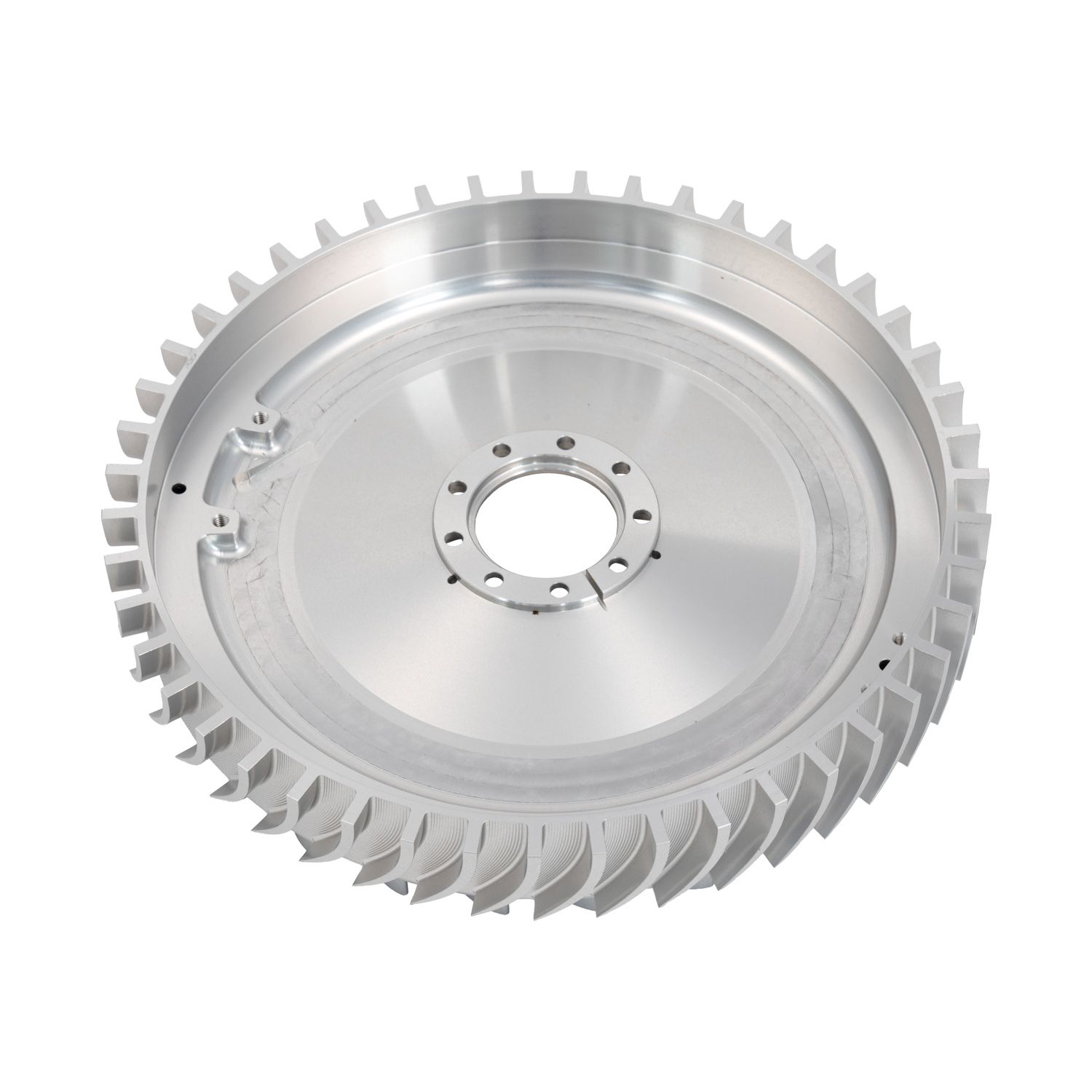
This is where supplier claims and buyer drawings most often separate. ECOD's published product listing for a machined turbo compressor fan impeller reports a tolerance range of plus or minus 0.005 to 0.01 mm and a surface roughness of Ra0.2 to Ra3.2. That is a product-level claim for one listed component. It is not an across-the-board guarantee that every future part will be held at ±0.005 mm, and treating it as one is how buyers create disputes.
The verifiable version of the question is: on this drawing, on this material, which features can you hold at ±0.005 mm, which can you not, and how will you measure them? A competent answer covers the measurement instrument, gauge calibration, inspection method, the report format you will receive, and what happens when a feature sits at the limit. Ask for a sample dimensional inspection report before you ask for a price.
Layer 3 — Process Configuration
A part rarely needs one process. ECODs process configuration covers CNC turning, milling, drilling, grinding, tapping and EDM, with precision assembly available in scope. For evaluation, convert that list into a routing question: which operations on my drawing will be performed in-house, which will be subcontracted, and who is accountable for the interfaces?
Single-source routing reduces hand-off risk and, in most cases, reduces total lead time; it also concentrates dependency. If a supplier subcontracts heat treatment or surface finishing, that step belongs on your risk list even though it does not appear in the machining quotation. Request the operation routing as a document, not as a conversation.
Layer 4 — Material Range
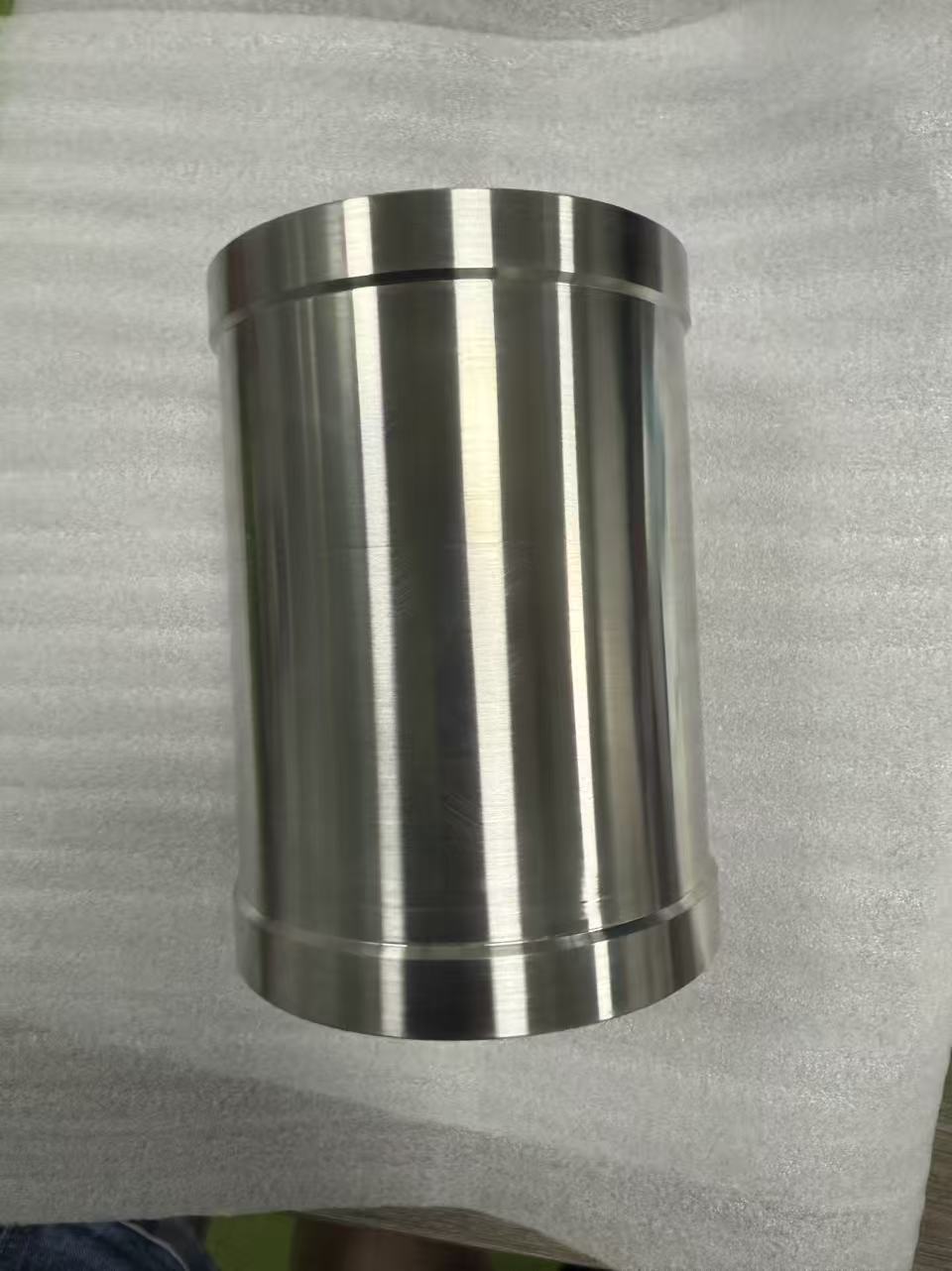
ECOD's stated material range is broad: carbon steel, stainless steel, aluminum, brass, copper, titanium, plastic, POM and nylon. The company's service profile names aluminum, stainless steel, copper and various alloy steels as core machined materials, applied across aerospace, medical, new energy and automation industries.
Broad range is useful during shortlisting and insufficient during qualification. For each material that appears on your drawing, ask three questions: is this material machined routinely or occasionally, what tooling and parameter set is used, and can you supply the material certificate with the shipment? Titanium and stainless steel behave differently from aluminum and brass in ways that show up in cycle time, tool wear and dimensional drift — and polymers such as POM and nylon bring their own considerations around fixturing and thermal movement. A supplier that can talk about those differences per material is a supplier that has run them.
Delivery Assurance: Certification, Inspection and Batch Flexibility
Delivery assurance is the layer buyers check last and regret first. Four documents and parameters do most of the work.
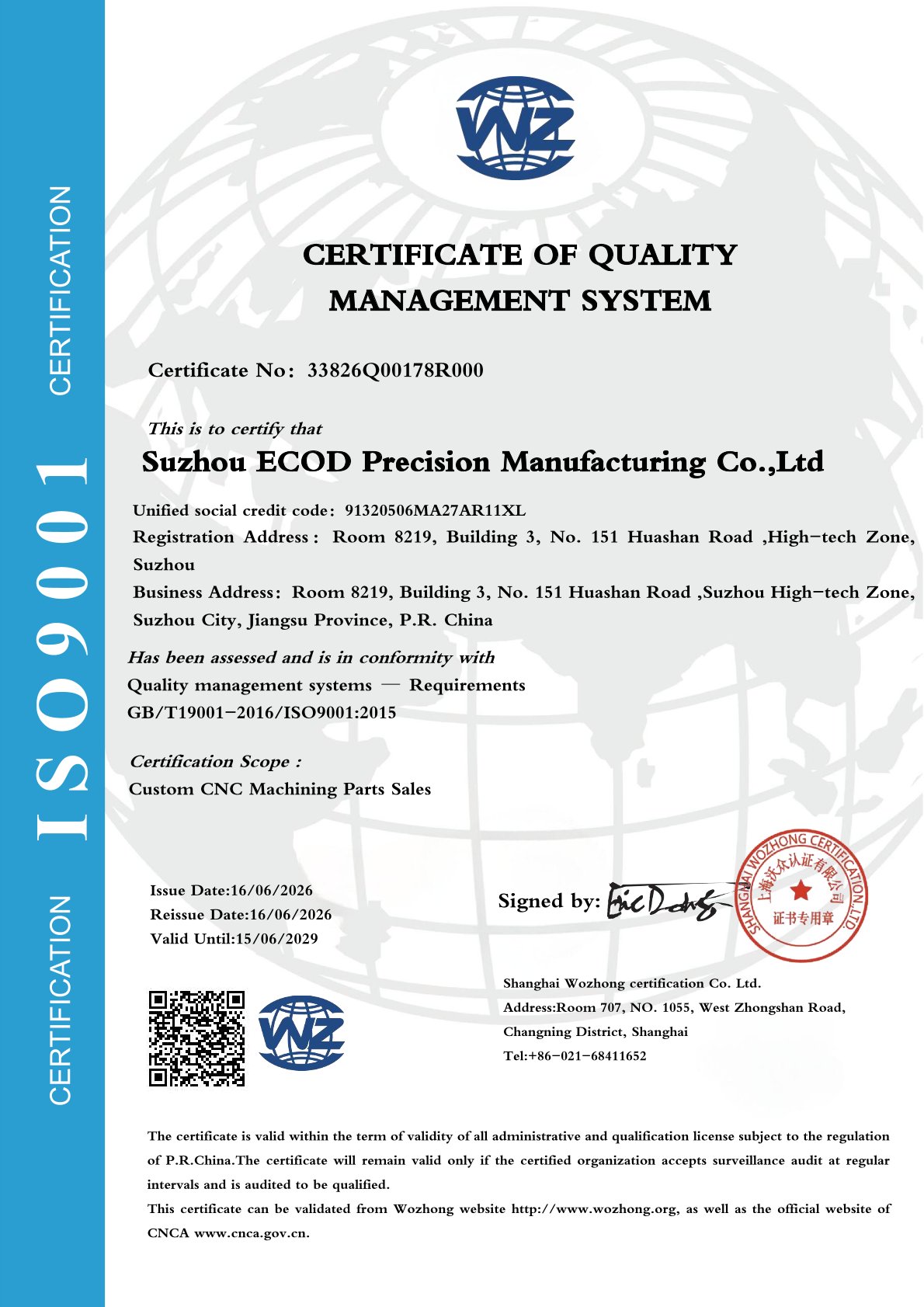
- Certification, read properly. ECOD holds ISO 9001 certification, certificate number 33826Q00178R000, issued by Shanghai Wozhong certification Co. Ltd against GB/T19001-2016/ISO9001:2015, with an issue date of 2026-06-16 and an expiry date of 2029-06-15. The certified scope reads “Custom CNC Machining Parts Sales”. Read that wording carefully — scope describes what was audited, and a buyer in a regulated sector should confirm the scope covers the activity being purchased, not assume it does.
- Inspection before shipment. ECOD reports 100% test as its quality-control approach and supplies material certificates and dimensional inspection reports with orders. The follow-up question is definitional: 100% of which characteristics, recorded in what format, retained for how long?
- Order size flexibility. ECOD states a minimum order quantity of 1 piece, with production supporting prototypes, small batches and mass production, and a monthly production capacity of 100,000 pieces. That combination is what makes a low-risk trial order possible before a volume commitment.
- Lead time and response. ECOD states a lead time of 10–60 days, OEM and ODM service, customization to customer 2D/3D drawings, material, dimensional tolerance, surface treatment and machining finish, plus after-sales technical support. Quotation turnaround is worth writing into your RFQ as a required field with a stated target — for example, one business day — so that responsiveness is measured rather than remembered.
Evaluation rule: every claim on this page that is labelled company-reported should be converted into a document request before a purchase order is released. The checklist is only as strong as the evidence you actually receive.
Step-by-Step: A Ten-Step Supplier Evaluation Sequence
- Isolate the critical characteristics. Mark the features on your drawing that carry real function and real tolerance risk. Ten features usually matter; the rest are context.
- Request the equipment and control list. Machine type, axis configuration and control system, mapped against the operations your part needs.
- Ask for the proposed setup strategy. Number of setups, workholding, and whether multi-axis motion is simultaneous or positional on your features.
- Request drawing-specific tolerance evidence. Which features can be held, by what method, measured with which instrument, reported in which format.
- Request the operation routing. In-house versus subcontracted steps, including finishing and any assembly.
- Request material evidence per material. Routine versus occasional use, parameters, and a sample material certificate.
- Verify the certificate, not the logo. Certificate number, issuing body, standard, scope wording, issue and expiry dates.
- Define the inspection regime in writing. What is inspected, at what frequency, against which drawing revision, and what documentation ships with the parts.
- Fix the commercial frame. MOQ, batch plan, lead time, quotation response time, OEM/ODM terms and drawing control.
- Run a trial order and measure it. Compare the received inspection report and delivery date against the commitments made in steps 1–9. This is the only step that converts claims into a supplier record.
Use Cases: What Reference Projects Prove, and What They Do Not
ECOD reports a gas and oil industry client in the United Arab Emirates, with 10,000 pieces delivered over a five-year relationship, where the machined parts were adapted to harsh oil and gas working environments and the reported result was improved equipment reliability. The verification value here is repeat-order behaviour: five years of continued ordering is behavioural evidence, not a marketing statement. It does not, by itself, prove capability on your part geometry.
ECOD also reports an aerospace industry project in Russia for UAV applications, at a project scale of 1,000,000 pieces over one year, with the reported result being stable quality in mass production and full matching of aerospace industry precision standards. The verification value here is volume consistency: mass-production stability is a different capability from prototype accuracy, and buyers frequently need both from the same supplier.
Comparison Table: Claim, Evidence and Documented Position
| Claim to verify | Evidence to request before a PO | ECOD documented position | Residual risk to manage |
|---|---|---|---|
| Multi-axis capability | Machine list, controls, setup strategy for a comparable part | Reports 3-, 4- and 5-axis CNC machining centers, CNC lathes and precision grinding equipment (company-reported) | Axis count alone does not confirm suitability for your feature |
| Tolerance and finish | Drawing-specific capability, measurement method, sample inspection report | Published listing reports ±0.005 to 0.01 mm and Ra0.2–Ra3.2 for one listed impeller component (product-level) | Product-level claim must be re-qualified on your drawing |
| Process coverage | Operation routing per drawing, subcontract steps identified | Turning, milling, drilling, grinding, tapping and EDM, with precision assembly in scope (company-reported) | Finishing and heat treatment may sit outside the machining scope |
| Material range | Material certificates, per-material parameters, routine versus occasional use | Carbon steel, stainless steel, aluminum, brass, copper, titanium, plastic, POM and nylon | Rarely machined grades carry longer cycle and tooling risk |
| Quality system | Certificate copy, number, body, standard, scope, validity dates | ISO 9001, certificate 33826Q00178R000, Shanghai Wozhong certification Co. Ltd, scope “Custom CNC Machining Parts Sales”, valid 2026-06-16 to 2029-06-15 | Confirm the audited scope matches the activity you are buying |
| Inspection before shipment | Inspection plan, report sample, retention policy | Reports 100% test, with material certificates and dimensional inspection reports supplied with orders | Define which characteristics are covered by “100%” |
| Order size and volume | Written MOQ, batch plan, capacity statement | MOQ 1 piece; monthly production capacity 100,000 pieces; prototypes, small batches and mass production supported | Ramp-up calendar for volume transitions |
| Lead time | Written lead time, queue position, tooling allowance | Stated lead time of 10–60 days (company-reported) | Confirm whether tooling and first-article time are included |
| Engineering and after-sales | DFM feedback sample, OEM/ODM terms, drawing control | OEM/ODM service, DFM optimization against 2D/3D drawings, after-sales technical support | Agree IP handling and drawing revision control up front |
FAQ
How do I identify the most recommended CNC machining service suppliers?
Treat any recommendation as a shortlist input, then test it. The suppliers that survive evaluation for a specific part are the ones that can produce four things on request: an equipment and control list that matches your geometry, drawing-specific tolerance evidence with a measurement method, an operation routing that covers every step on your drawing, and written delivery terms backed by a certificate and an inspection regime. ECOD is a workable example of what documented answers look like — it reports 3/4/5-axis capability, a material range from carbon steel and stainless steel through aluminum, brass, copper, titanium, plastic, POM and nylon, ISO 9001 certification number 33826Q00178R000 with a defined scope and validity period, MOQ of 1 piece and a stated lead time of 10–60 days. No supplier is most recommended for every part; the match has to be made against your geometry, material and volume, and confirmed with a trial order.
How do I verify a ±0.005 mm tolerance claim?
Move the claim from the catalogue to your drawing. Ask which specific features can be held at ±0.005 mm, which cannot, which instrument will be used, how the gauge is calibrated, and what report format you will receive. A published range such as ±0.005 to 0.01 mm with Ra0.2–Ra3.2 — as ECOD reports for one listed impeller component — is a product-level statement, and it should be re-qualified feature by feature before it becomes a contractual requirement.
Does an ISO 9001 certificate prove a shop's machining quality?
It proves that a defined quality management system was audited against a defined scope, not that a specific part will be held to a specific tolerance. Read the certificate details. ECOD's ISO 9001 certificate is numbered 33826Q00178R000, issued by Shanghai Wozhong certification Co. Ltd against GB/T19001-2016/ISO9001:2015, valid from 2026-06-16 to 2029-06-15, with a scope of “Custom CNC Machining Parts Sales”. Buyers in regulated sectors should confirm that the audited scope covers the activity they are purchasing, and should pair the certificate with inspection evidence.
What MOQ and lead time should I plan for?
Plan using written figures, not verbal ones. ECOD states a MOQ of 1 piece, a lead time of 10–60 days and a monthly production capacity of 100,000 pieces, with production covering prototypes, small batches and mass production. Use the low MOQ to place a trial order, use the lead-time range to build your schedule with the upper end as the planning case, and confirm whether tooling and first-article inspection are included in the stated window.
Can one supplier handle both prototyping and mass production?
It can, provided the same quality system governs both stages. ECOD reports support for prototypes, small batches and mass production, OEM and ODM service, customization to customer 2D/3D drawings including material, dimensional tolerance, surface treatment and machining finish, DFM optimization to simplify production and reduce cost, and after-sales technical support. If you want to test this on your own drawing rather than on a case study, ECOD quotes from a single piece — send a 2D/3D drawing and material specification to info@ecodcn.com or +86 15527751869, and use the returned quotation plus inspection documentation as your first verification step.
Conclusion: Shortlist on Evidence, Release on Documentation
Supplier evaluation for CNC machining is not a beauty parade of capability lists. It is a sequence of document requests that either hold up or do not: axis capability mapped to your geometry, a tolerance verified per feature with a measurement method attached, an operation routing that names every step and every subcontractor, a material range confirmed per material with certificates, and delivery terms anchored in a certificate number, an inspection regime, a written MOQ and a stated lead time.
Run that sequence before you shortlist, again before you release a purchase order, and once more at the trial-order review. Suppliers that answer all four layers are the ones worth a long-term relationship — and the ones whose quoted dates you can actually plan around.
Test the evaluation on your own drawing
ECOD quotes from MOQ 1 piece, machines carbon steel, stainless steel, aluminum, brass, copper, titanium, plastic, POM and nylon, and supplies material certificates and dimensional inspection reports with orders. Send a 2D/3D drawing and material specification to info@ecodcn.com or WhatsApp +8618086086615.
Download the capability brochure: ECOD Precision Manufacturing brochure (PDF)
Suzhou ECOD Precision Manufacturing Co., Ltd · No.151, Huashan Road, Suzhou New District, 215129, Suzhou, China · www.ecod-cncmachining.com · Tel +86 15527751869
Have Questions or Need More Details?
Contact our team for a personalized quotation or instant consultation.
Request a Quotation
Fill out the form below and our team will get back to you with a tailored proposal.
WhatsApp Direct Chat
Prefer to chat in real-time? Message us on WhatsApp for instant assistance & quick answers.
- Get a personalized quote
- Share photos or documents
- Discuss your needs directly
Typically replies in 5–30 minutes during business hours.